
The Biggest Threat to a Fraud Investigation Isn’t Always the Fraudster
November 05, 2026
By Lavan Sarat Pattii, CPA, CIMA, CGMA, LLB, CA (India), CMA (India)
Every accounting fraud is first a behavioural failure before it becomes a financial failure. Every forensic investigation is built upon evidence, and modern forensic technology has significantly enhanced our ability to analyse such evidence with remarkable speed and precision. However, there remains one category of evidence that receives surprisingly little attention despite being present at the beginning of almost every fraud: human evidence.
Picture this …
A finance executive notices that an invoice has been approved twice.
The documentation appears complete. The approvals are in place. The payment falls within the delegated authority. Nothing, at
first glance, appears unusual. Yet something does not feel right. She considers discussing it with her manager but hesitates. Six months earlier, another colleague questioned an unusual transaction and was quietly removed from a critical project. Although no formal action was ever documented, everyone in the department understood the message.
She closes the file, the payment proceeds.
No forensic accountant is appointed. No regulator becomes involved. No whistleblower complaint is filed. No investigation commences. Most organisations would conclude that nothing happened, as forensic professionals, we should reach a very different conclusion.
Not because evidence was destroyed, but because the first and most important evidence was never allowed to exist.
Looking Beyond Traditional Evidence
For many years, forensic accounting has focused on discovering evidence after wrongdoing has occurred. We analyse accounting records, reconstruct fund flows, recover deleted electronic data, examine digital devices, interview witnesses and prepare reports capable of withstanding judicial scrutiny. These are fundamental responsibilities of every forensic professional.
Yet experience continually reminds us that the success of an investigation is rarely determined by the sophistication of investigative techniques alone. More often, it is determined much earlier, when an ordinary employee decides whether integrity is safer than silence.
For this reason, I believe the greatest threat to a fraud investigation is not always the fraudster.
It is the environment that convinces honest people not to speak.
The Human Evidence Theory
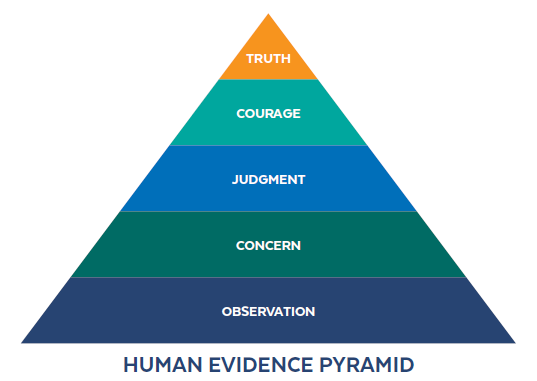
Human evidence is neither documentary nor electronic. It exists within people. It consists of observations, professional judgments, ethical instincts, memories, concerns and contextual understanding possessed by individuals closest to business activities. It can be developed through five distinct stages in what I like to call the human evidence pyramid.
1. Observation: An employeenotices something unusual. At this point, there is no allegation, only professional curiosity.
2. Concern: The observation begins to conflict with the individual’s understanding of ethical business conduct. Questions emerge. Why was this approval bypassed? Why does this vendor appear repeatedly? Why has this transaction been structured differently?
3. Judgment: The individual weighs professional responsibility against personal consequences. This stage is rarely discussed, yet it is perhaps the most critical. The employee is no longer evaluating the transaction. Instead, they are evaluating the organisation.
4. Courage: If organisational culture inspires confidence, the individual decides to report the concern. If the organisation has demonstrated intolerance towards dissent, silence prevails.
5. Truth: Only after these earlier stages succeed does the investigator receive meaningful evidence to initiate a formal forensic engagement.
So, long before an unexplained payment appears in a forensic report, someone has questioned its commercial rationale. Before an internal control weakness becomes an audit observation, someone has recognised unusual behaviour. Before regulators initiate enforcement proceedings, an employee has often asked themselves a simple but profoundly important question: Why does this not seem right?
That moment represents the earliest form of evidence available to any organisation.
Unfortunately, it is also the easiest evidence to lose.
Unlike financial records, human evidence cannot be restored from backup servers. It cannot be recovered through forensic imaging. It cannot be recreated using artificial intelligence. Once fear replaces trust, human evidence begins disappearing—not because facts cease to exist, but because individuals conclude that remaining silent is safer than telling the truth.
This, in my view, represents one of the most underestimated risks in modern forensic investigations.
Professional Standards Reflect the Same Philosophy
It is noteworthy that globally recognised professional frameworks arrive at remarkably similar conclusions.
The AICPA Statement on Standards for Forensic Services requires integrity, objectivity, due professional care, professional competence, sufficient relevant evidence and independent professional judgement throughout forensic engagements.
Similarly, the ICAI Forensic Accounting and Investigation Standards emphasize independence, integrity, confidentiality, due professional care, separation of facts from opinions and the Primacy of Truth as foundational principles governing forensic assignments.
The COSO Internal Control—Integrated Framework provides a further connection. COSO identifies the control environment as the foundation of an effective system. Environments are shaped by an organisation’s commitment to integrity, ethical values, board oversight, management’s tone at the top, appropriate structures and lines of authority, competence and accountability. Although COSO does not use the term human evidence, its principles reinforce the same underlying idea: when leadership creates an environment in which employees can raise concerns without fear, information reaches those responsible for governance. When retaliation suppresses that communication, both the control environment and the organisation’s ability to identify misconduct are weakened.
Although developed for different professional and governance purposes, these frameworks recognise an important reality, truth cannot emerge where evidence is compromised and evidence cannot emerge where people are afraid to speak. Consequently, preserving human evidence is consistent not only with the ethical foundations of modern forensic accounting but also with the conditions necessary for a sound control environment.
How Retaliation and Silence Destroys Human Evidence
Many organisations mistakenly interpret the absence of complaints as evidence of an ethical culture.
Experience suggests precisely the opposite.
The most damaging frauds rarely flourish because perpetrators possess extraordinary intelligence. They flourish because organisational culture gradually teaches employees that difficult questions carry personal consequences.
Fear rarely arrives through formal policy. Instead, it develops quietly.
Every employee who experiences retaliation influences dozens of colleagues who observe the consequences. Without issuing a single policy, the organisation communicates that integrity carries personal risk.
An employee who raised concerns is excluded from strategic meetings, another unexpectedly receives adverse performance feedback, someone else is transferred without explanation. Each event appears insignificant in isolation. Collectively, however, they communicate a powerful organisational message: Protect your career before you protect the organisation.
From that moment onwards, silence becomes rational behaviour.Eventually, employees stop reporting, managers stop asking difficult questions, witnesses stop volunteering information, the organisation loses not only a whistleblower but also the opportunity to discover misconduct while corrective action remains possible.
For investigators, this has profound implications because by the time investigators are appointed, valuable Human Evidence has already disappeared.
What History Continues to Teach Us
Few corporate failures illustrate this reality more clearly than Enron.
Long before its collapse, Sherron Watkins had already raised internal concerns about accounting practices. History demonstrates that the organisation possessed an opportunity to confront the underlying issues while corrective action remained possible. Instead, the concerns were not effectively acted upon, and the subsequent events became one of the defining corporate failures of modern times. The enduring lesson is not simply that accounting fraud occurred; fraud has existed throughout history.
The more important lesson is that organisations frequently receive early opportunities to prevent catastrophic failures. Those opportunities arrive through people. When organisations fail to preserve human evidence, they also fail to preserve the future integrity of their investigations.
The Investigation Iceberg
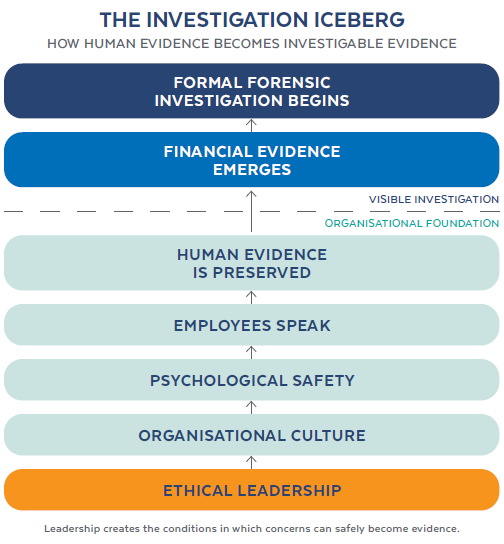
Traditional thinking views investigations primarily through their visible outputs: document reviews, interviews, digital analysis, expert reports and courtroom testimony. These activities certainly represent the visible face of forensic accounting.
However, they constitute only the tip of what I describe as the Investigation Iceberg.
Beneath every successful investigation lies an invisible foundation comprising ethical leadership, organisational culture, psychological safety, governance maturity and institutional trust. This perspective fundamentally changes how organisations should approach fraud prevention. Investments in forensic technology undoubtedly improve investigative capability. However, investments in organisational trust preserve the evidence upon which every investigation ultimately depends.
Technology detects anomalies. People explain intention. Accounting systems record transactions. People preserve truth.
A Call to Boards, Audit Committees and Investigators
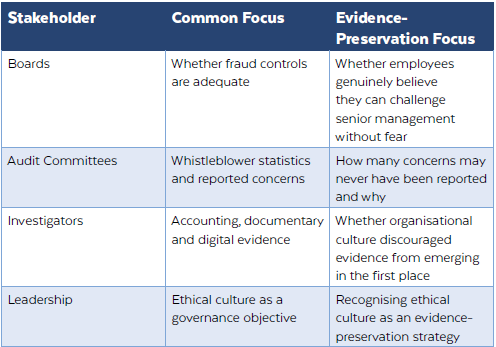
Preserving human evidence requires key stakeholders to look beyond conventional fraud indicators and consider whether the organisation enables concerns to emerge.
Conclusion & Reflection
If you were leading an organisation today, what would concern you more: the fraud you discovered or the fraud that no one felt safe enough to report?
As forensic professionals, we are trained to discover facts after misconduct has occurred. Yet the future of forensic accounting may depend equally upon preserving the conditions that allow those facts to emerge before misconduct becomes systemic.
Financial evidence will always remain indispensable, digital evidence will continue evolving. Artificial intelligence will transform investigative methodologies, yet none of these developments can replace the courage of an individual who chooses integrity over silence.
Perhaps the future of forensic accounting lies not only in building better investigative technologies but also in building organisations where truth is never treated as an act of disloyalty.
Every accounting fraud begins as a behavioural failure before it becomes a financial failure. Every fraud leaves financial evidence, but only ethical organisations preserve human evidence and perhaps that is the first evidence every forensic investigator should learn to protect.