Beyond the Buzz: Practical AI Applications for Arizona CPAs
January 16, 2026
By Barry S. Graham, CPA, CMA
Senior Audit Manager, Wallace, Plese + Dreher, LLP
Artificial Intelligence (AI) is everywhere — dominating headlines, boardroom discussions and even staff meetings. From “Jobocalypse Now” to “The AI Grim Reaper,” there may be a growing temptation to believe this technology is poised to take over accounting. But in the real world – especially for Arizona CPAs working with private companies, the story is far more nuanced.
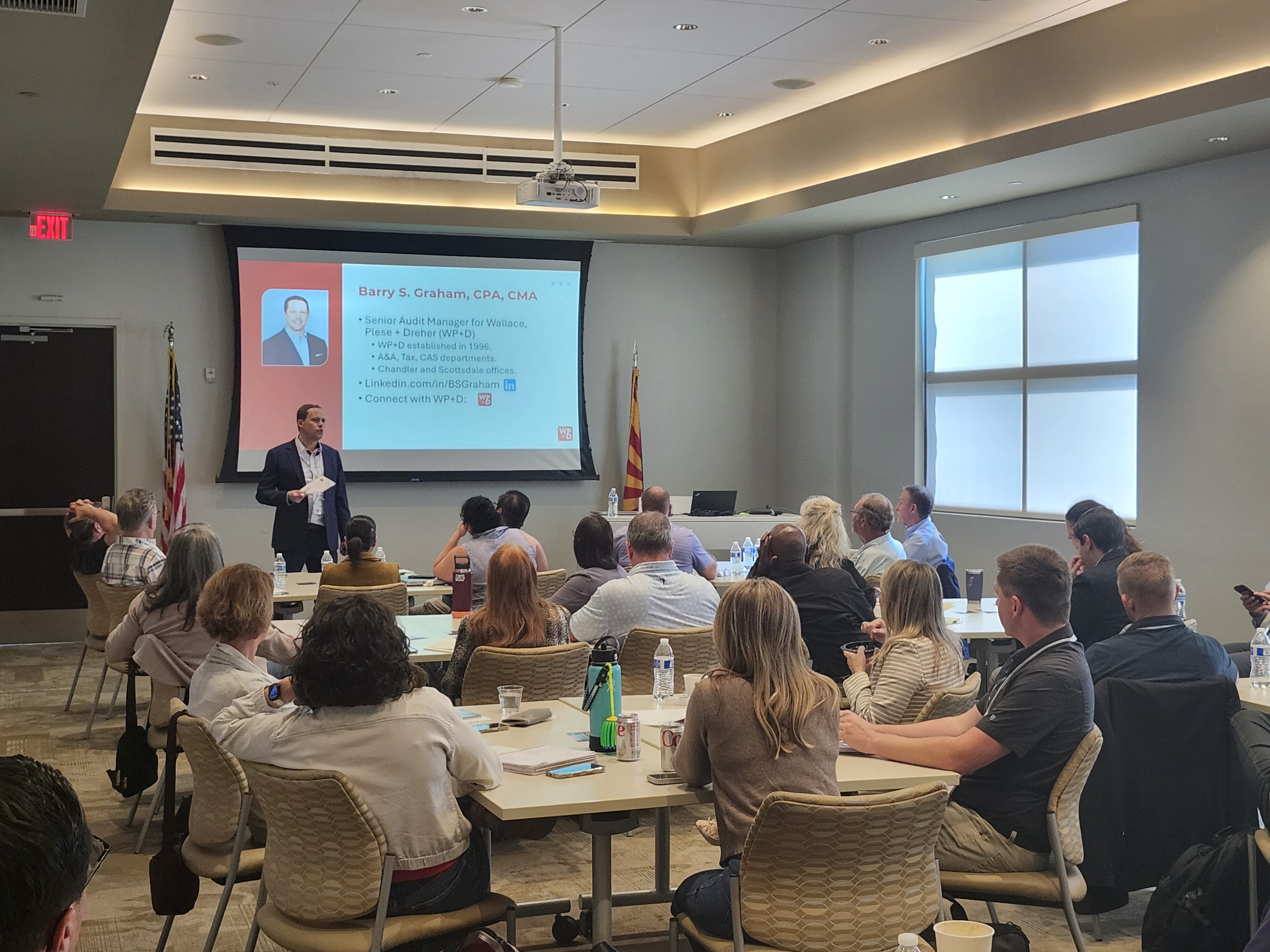
Barry Graham presenting at ASCPA Converge 2025.
After presenting Practical AI for CPAs at the ASCPA’s 2025 Converge Conference and Arizona Tax Workshop, I’ve continued speaking with peers and clients about how AI tools can be both powerful and problematic. The key takeaway? AI isn’t coming for your job, but CPAs who embrace it thoughtfully may outpace those who don’t.
What AI Gets Wrong — and Why It Matters
Large language models like ChatGPT, Gemini and Grok can generate fast responses — but not always accurate ones. In fact, AI often prioritizes delivering an answer — right or wrong — over admitting uncertainty. That alone should raise concerns for professionals who rely on precision.
At Wallace, Plese + Dreher (WP+D), we’ve encountered this firsthand. Our tax partner, Hannah Oglesby asked an AI tool about suspended passive activity losses under IRC §469. The model initially got it wrong until Hannah presented the relevant code section. It then corrected course and acknowledged that, under §469(f), suspended PALs can offset nonpassive income from the same self-rental.
Similarly, managing partner, Randy Brammer, queried a GPT model about whether gross margin analysis met SSARS 21 requirements. The tool said yes, until Randy showed it the AR-C 90 text, at which point it admitted that gross margin alone doesn’t fully satisfy the disaggregated revenue analysis requirement.
Why do these tools miss the mark? Despite rapid development, we continue to see common issues:
- Outdated data.
- Confusion between federal, state and international rules.
- Hallucinated citations or misread code sections.
- Lack of access to real-time IRS or FASB updates.
- Struggles with exceptions and edge cases.
In short, they still lack what we as CPAs are trained to apply: professional judgment.
Where AI is Already Saving Time
Despite these limitations, AI delivers measurable value. At WP+D, we’re already using it to reduce hours spent on routine tasks and to improve consistency, especially during busy season. Here are some of the basic ways you can start using AI:
- Converting PDFs into usable formats.
- Drafting internal control documentation for audits.
- Drafting footnote disclosures or policy memos.
- Generating email templates to clients and other contacts.
- Performing initial research (with source verification).
- Drafting IRS elections, amendment explanations or penalty abatement letters.
- Creating Excel formulas or financial schedules.
For accountants in private industry, AI can assist with drafting capitalization, PTO or other corporate policies, as well as related party agreements — under appropriate legal review. These are areas where GPT tools, when prompted well and professionally reviewed, provide real productivity gains.
A Real-World Case: Busy Season Engagement Cleanup
Consider a recent financial review engagement for a C corporation client with $30 million in annual revenue. After fieldwork wrapped, management submitted six late-stage journal entries — including material adjustments to inventory and accrued payroll.
Rather than starting from scratch, we used GPT to assist in multiple ways. It helped us draft a memo that clearly documented the entries and the related procedures, summarized the review steps and conclusions, and supported revisions to the client’s tax provision. We also had it generate a checklist to track all potentially impacted workpapers. Once the AI had context on these out-of-scope tasks, we even asked it to draft a billing summary for the additional work.
This hybrid approach significantly accelerated our process, but every output was carefully reviewed through the lens of professional standards and CPA judgment. That’s where the profession is headed — AI as a force multiplier, not a replacement.
Know the Limits: Ethics, Privacy and Skepticism
As AI becomes embedded in firm workflows, we must remain cautious and ethical in its application. At WP+D, we adhere to several guiding principles to ensure responsible use.
First, we emphasize the importance of professional verification — AI outputs should always be validated against authoritative sources such as the FASB Codification, AR-C guidance or the Internal Revenue Code. We also maintain strict confidentiality protocols and never input client-sensitive data into public AI platforms.
Another key practice is avoiding any implication that AI is an authoritative source. It should be viewed as an assistant — helpful, but not definitive. Above all, we apply professional skepticism to every AI-generated response, treating it with the same scrutiny we would apply to other third-party evidence.
To support consistency and compliance, firms should also develop internal guidelines governing how AI is used in tax, audit and consulting services.
The Real Advantage Is Still Human Judgment
AI tools can enhance what we do, but they can’t replace our professional reasoning, ethics or industry context. Just like Excel didn’t eliminate accountants but empowered them, AI has the potential to improve efficiency and free up time for higher-level tasks.
Think of it this way: search engines show you where to look; AI attempts to give you the answer. Your job is to make sure that answer is correct.
Whether you work in audit, tax, CAS or industry, AI is quickly becoming a standard tool — just like spreadsheets or engagement software. The question isn’t whether to use it, but how to use it well.
Final Thoughts
The real disruption isn’t that AI will take our jobs — it’s that CPAs who are slow to adopt it may fall behind. The future of our profession isn’t human versus machine — it’s human with machine. And in that future, CPAs who lead with ethics, judgment and adaptability will thrive.